
Understand the role of the assembly
During plasticizing, the non-return valve permits material to move toward the front of the screw. During injection, it must restrict backflow so the injection unit can transfer movement and pressure into the material. ENGEL explains this function as part of its process-improvement guidance. The screw tip, ring and seat should therefore be considered as related parts rather than unrelated catalogue items.
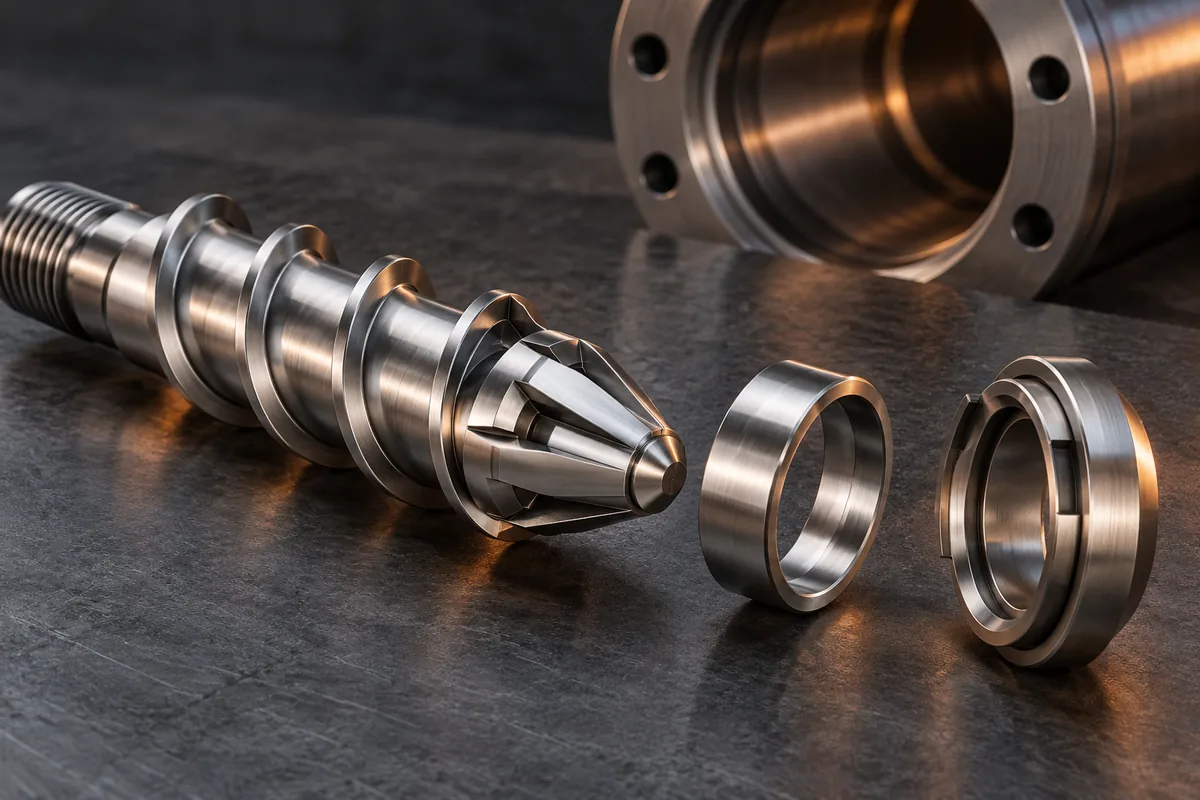
Different valve designs exist. Identify the actual design and approved drawing before ordering a replacement. A photograph helps a reviewer recognize the arrangement, but it does not establish the correct thread, material pairing or fit. The illustration with this article is a conceptual grouping of components, not a drawing for assembly or an approved replacement specification.
Record a pattern, not an isolated cycle
Document which machine, mold, material and production condition produced the concern. Note whether the issue is new, intermittent or associated with a change in job or material. Keep the original observations and distinguish them from the team's explanation. This makes it possible to compare like with like rather than treating every variation as the same fault.
Asaclean's article discusses injection-cushion and cycle-consistency symptoms in the context of a non-return valve. That is useful background, but the symptoms are not a complete diagnosis. Other process and equipment variables may need review. A competent process specialist should determine which observations or machine-approved tests are appropriate for the actual system.
Do not improvise a blocked-nozzle test, alter safety functions or dismantle a hot or pressurized assembly on the basis of an online article. Inspection and testing must follow the equipment manufacturer's procedures, safe isolation requirements and the plant's qualified maintenance process. This guide provides an evidence checklist, not an operating instruction.
Make an evidence packet that another reviewer can use
Organize the packet into three sections: process observations, component identity and inspection findings. For each process observation, identify the date, operating context and the person responsible for the record. For component identity, include the machine identifier, valve design, drawing revision and the parts that are intended to remain in use.
If an inspection has been performed, preserve the documented locations, measurement conditions, tool identification and applicable references. Label photographs so a reviewer can connect each image to the component and orientation. Report an unavailable value as unavailable. Do not estimate a sealing feature from a photograph and then present the estimate as an accepted dimension.
A useful original question list is: What changed? What stayed the same? What was actually observed? Which alternative explanations remain? What evidence would distinguish them? These questions help both production and maintenance agree on the next investigation without requiring a premature decision about which part to buy.
Define the replacement boundary
Before requesting a quotation, state whether the project covers a ring, tip, seat or complete matched group. Identify retained interfaces and any condition findings that may affect compatibility. A new ring cannot be specified reliably by appearance alone. Ask the supplier which drawings and inspection information are needed to review the proposed boundary.
Keep commercial urgency separate from technical acceptance. A quick shipment is useful only if the supplied parts meet the agreed design and scope. Confirm identification, material documentation and inspection records before approval. Where a supplier offers an alternative design, the change should be reviewed explicitly rather than hidden inside a part-number substitution.
For a hypothetical example, a buyer may have a clear photograph but no approved drawing revision and no documented inspection of retained parts. The next step is to resolve those gaps. The photo is useful evidence of appearance, but it is not proof that a visually similar set will fit. This is an illustrative procurement example, not a Hongfa service case.
Keep the learning after the repair decision
Record the approved action and the evidence used to make it. If components are replaced, identify the supplied parts and retain a comparable follow-up record under the plant's normal process. Avoid claiming the cause has been proved simply because one component was changed.
Read the front-end component overview and quality information guide before preparing the local project brief. Downloading the project brief saves a file on your device; it does not send an inquiry or upload drawings. Email project information you are authorised to share to [email protected]. Final component supply and technical suitability remain subject to confirmed project information.
Sources and further reading
- ENGEL - Common problems with a non-return valve
- Asaclean - Injection Molding Troubleshooting: Focusing on the Non-Return Valve
Technical background sources are identified above; their product claims do not establish Hongfa capability or material equivalence. Technical reviewer: pending assignment. Project-specific specifications and acceptance require qualified review.