
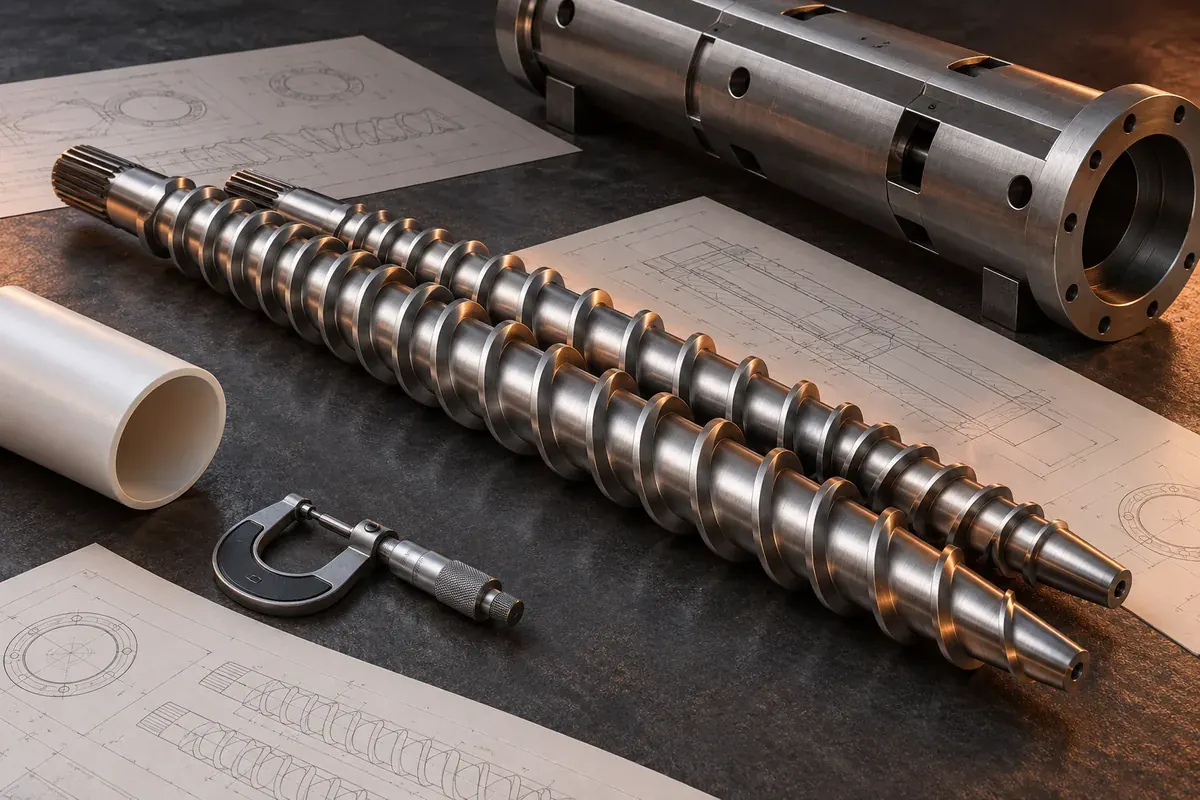
Start with a scope statement
Write one sentence defining the purchase. Is the project a matched screw pair, a barrel, a complete assembly or an investigation before deciding? Identify which existing components will remain. If only the screws are being replaced, the condition of the retained barrel belongs in the review. A nominal size or an old invoice can help identify equipment, but neither establishes every interface or the present condition of the parts.
List the machine make, model and serial identifier separately from the component drawing number. Attach the current drawing revision and record the source of any dimensions supplied by the plant. Where a dimension is unavailable, mark it as unknown instead of copying a value from a similar machine. A photograph can explain orientation and visible features; it does not establish a thread form, tolerance or matching clearance.
Describe the job without exposing unnecessary recipe details
The technical review needs to distinguish the polymer family, compound form, product and operating duty. A pipe line and a profile line should not be treated as the same application merely because both process PVC. Record the resin or compound identification, filler type, the basis used to express filler loading, reprocessed material content and any important formulation changes since the current components were supplied.
Use an agreed confidential exchange if detailed formulation information is commercially sensitive. A public website form should not be the default place for proprietary drawings or recipes. Downloading the Hongfa project brief saves a file on your device; it does not send an inquiry or upload drawings. Email project information you are authorised to share to [email protected]. Keep confidential documents within an approved receiving process when one is available.
Distinguish observed production from the intended target. Record what product and die were running when output, temperature or load observations were taken. A target is a requirement to assess, not a performance figure that the supplier has already guaranteed. If the application is changing, state the change explicitly so the quotation is not based on an obsolete duty.
Turn the requirement into a reviewable evidence list
Use a small evidence register rather than an unstructured email chain. Each item needs an owner, revision or observation date and an open question. A practical register can contain the following entries:
- Machine identification: plant maintenance owns the equipment record; purchasing confirms which machine the order covers.
- Assembly drawing: the drawing owner identifies the approved revision and the parts that remain in service.
- Process description: production identifies the current compound, product and relevant operating observations.
- Condition record: maintenance supplies inspection findings with positions and measurement conditions.
- Acceptance plan: buyer and supplier agree which dimensions, material records and identification marks will be checked.
This register is an organizational tool, not a substitute for an engineering drawing. Its value is making omissions visible before a supplier has to infer an answer. If two records disagree, retain both and ask the drawing owner to resolve the conflict; silently choosing the newer filename is not a reliable revision process.
Compare quotations on the same boundary
A lower price is difficult to interpret when one offer includes matching review and another covers only machining to the supplied drawing. Build a comparison sheet with separate rows for supplied components, retained interfaces, proposed material construction, inspection records, packaging, delivery assumptions and exclusions. Keep commercial terms distinct from technical acceptance.
For example, a hypothetical buyer may receive one offer for two screws and another for two screws plus a barrel. Those are different scopes, not evidence that one manufacturer is cheaper for the same work. Resolve the scope first. Likewise, a statement such as “wear resistant” needs a defined material proposal and application basis; it does not identify an alloy or establish service life.
Agree acceptance before placing the order
Ask which documents will accompany the components and how they will be connected to the delivered parts. Useful questions include whether the inspection record identifies the drawing revision, whether material documentation identifies the proposed construction and whether the supplied parts can be traced to their marks. The exact documents and acceptance limits must be agreed for the project; this article does not prescribe a universal tolerance.
Before releasing the purchase order, check that every unresolved item is visible to both sides. Record assumptions requiring approval and the person responsible for closing them. A complete RFQ does not eliminate technical discussion. It makes that discussion shorter and leaves a clearer record of what was actually agreed.
Prepare the next conversation
Use the conical twin component overview to identify the relevant product family and the selection guide to organize the project. Then prepare a local project brief. Supply and final specifications remain subject to confirmed drawings and project review; no output or lifetime is promised by this checklist.
Sources and further reading
- Reiloy USA - Screw & Barrel Handbook, eleventh edition
- Davis-Standard - Essential Feedscrew and Barrel Maintenance Part I
Technical background sources are identified above; their product claims do not establish Hongfa capability or material equivalence. Technical reviewer: pending assignment. Project-specific specifications and acceptance require qualified review.