
Products
Conical twin screws & barrels
A conical twin-screw project starts with the complete pair: screws, barrel geometry and the production task. For PVC pipe, profiles and CPVC projects, define the existing assembly before comparing construction options.
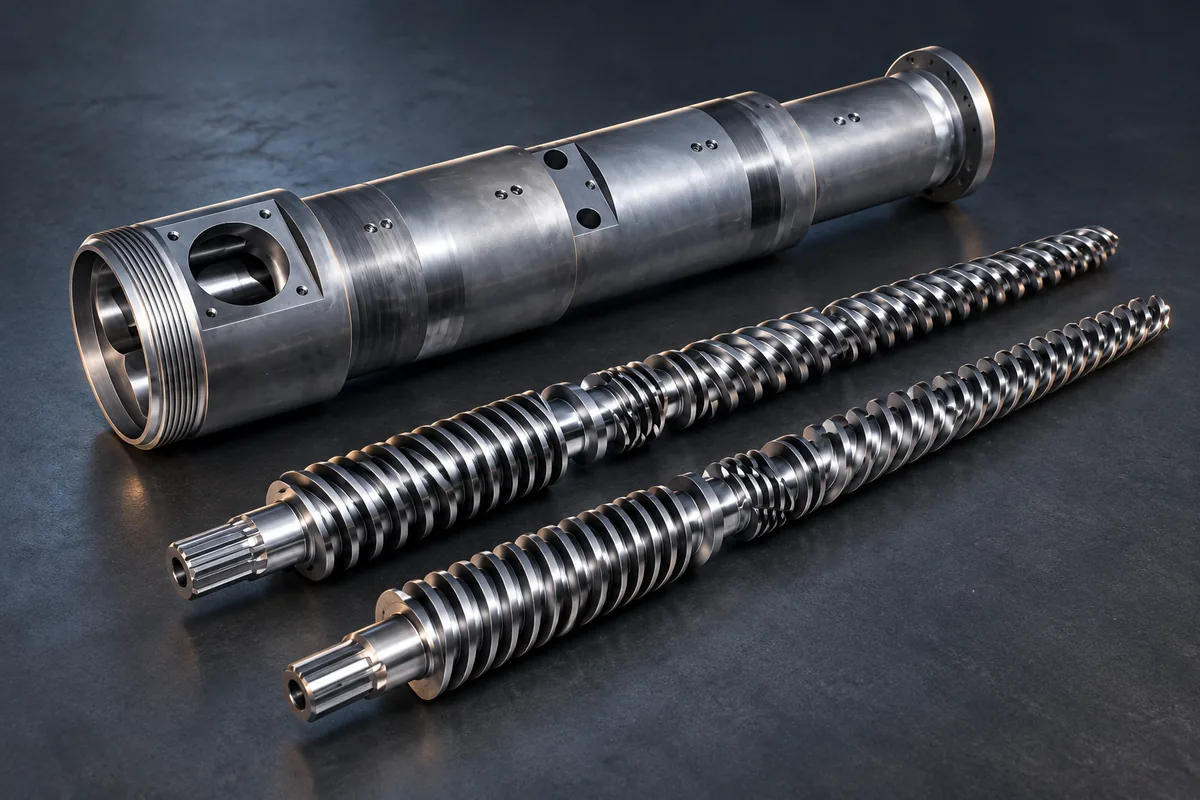
Conical geometry is the starting point
A conical pair changes diameter along its length. A parallel pair has a different geometry. Identify both ends, screw rotation, centre distances and the matched barrel before using a model code as a replacement reference.
Match the application and the assembly
Record whether the line produces pipe, conduit, profiles or foamed sheet. Add the material formulation, filler information, machine model and drawing revision. A photograph helps explain the layout; it cannot replace interface dimensions.
Compare construction with evidence
Nitrided and lined-barrel options should be discussed against wear, corrosion and the actual geometry. Ask for a defined material, treatment route and acceptance document. A trade name or an unqualified lifetime claim is not a material specification.
CPVC and spare-part requests
Keep the actual CPVC compound and operating context with the drawing pack. For mandrels, seals or connectors, identify the mating part and revision. The original Φ list is not a confirmed conical-model range.
| Review point | Record for the project | Why it matters |
|---|---|---|
| Geometry | Part drawing, revision, units and mating features | A component code does not define every interface. |
| Material & construction | Body grade, working surface or liner, treatment route | Body and working surface need separate descriptions. |
| Operating context | Polymer, formulation, filler and observed changes | A material comparison needs the application context. |
| Acceptance | Measurement positions, method and agreed criteria | The same basis is needed when comparing parts. |
Project downloads
A better brief.
A clearer next step.
Organize the machine, material, drawings and open questions before a technical discussion.