
Keep material identity separate from the product name
“CPVC pipe” describes a product family but does not identify a processing compound. Record the compound supplier, grade, physical form and current processing guidance. Keep this information separate from the service requirements of the finished pipe. A material's suitability for a piping application does not establish the operating conditions of the extruder that will make it.
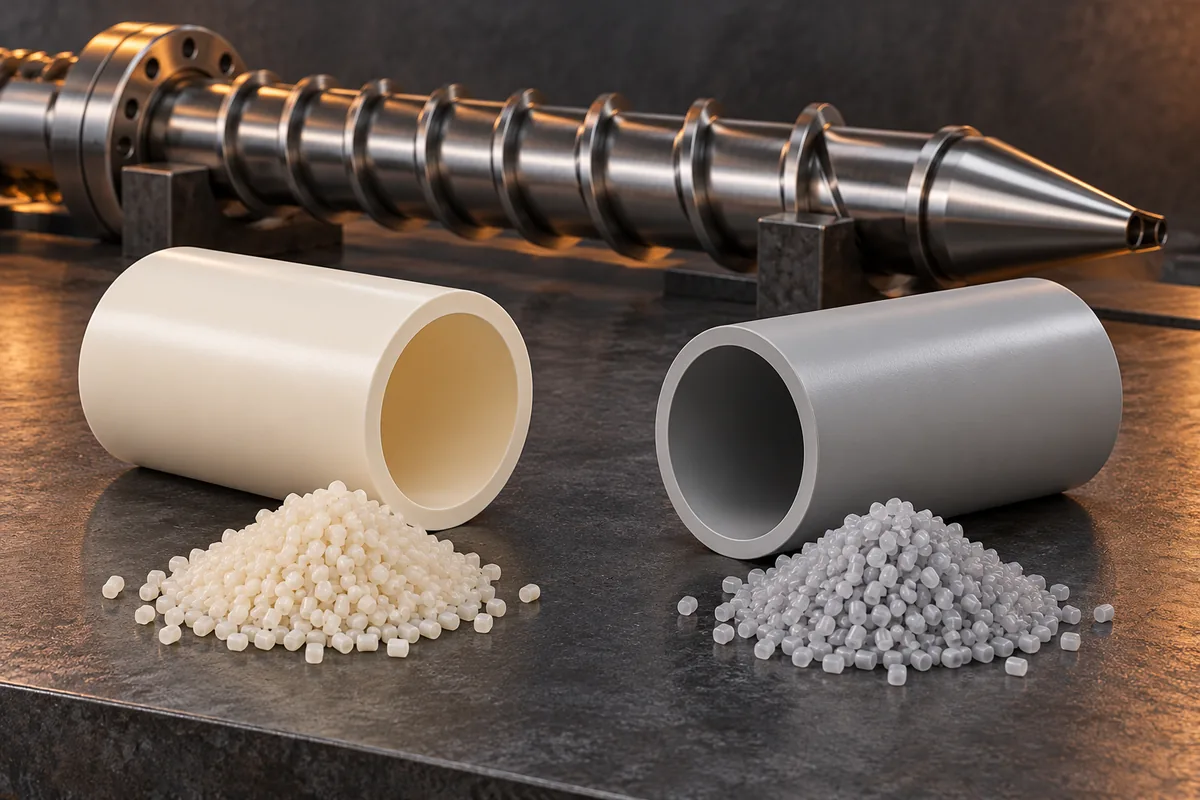
Lubrizol describes CPVC compounds as combinations of resin and additives, with properties and processability affected by formulation. That makes the compound identification useful evidence for a component discussion. It is not enough to replace the letters PVC with CPVC on an old quotation. Equally, pipe color or the appearance of granules cannot reliably identify a formulation; images in this article are conceptual only.
Review heat history as a system
SEKISUI's processing guidance highlights thermal stability and viscosity when comparing PVC with CPVC. These differences are reasons to review the system, not reasons to copy a temperature table from the internet. Compound guidance, machine configuration, screw geometry, actual material temperature and time spent in the equipment need to be considered together.
A useful review distinguishes a controller setpoint from an observed process condition. Record where the observation was made and what the line was producing. Also identify periods of interruption, slow operation or product change that alter the material's heat history. Avoid presenting one operating number without its context as a universal setting for every CPVC compound.
The operating procedure, ventilation, handling and response to abnormal conditions must follow the material supplier's and equipment manufacturer's instructions. This article is a project planning guide. It does not instruct an operator to alter temperatures, override protections or run an unapproved trial.
Check the assembly that will actually remain in service
Identify whether the planned project keeps the existing screw pair, barrel, drive, adapters and downstream equipment. Treat those interfaces as an assembly review. A new component can have the correct nominal size while leaving a different interface or a worn retained part unresolved. The drawing revision and an appropriate condition record therefore belong beside the material information.
Keep geometry and surface construction as separate review lines. Geometry concerns the way the assembly handles material; construction concerns the proposed substrate and working surface. A description such as “corrosion resistant” does not establish that the geometry suits the intended compound, and a geometry change does not establish a material specification. Ask for a reasoned proposal covering both.
Use a change register before requesting a recommendation
Make two columns headed “existing PVC duty” and “proposed CPVC duty.” Use rows for compound identification, finished product, die and adapters, supplied components, retained components, process observations and required product checks. Add a third column for the evidence owner. Blank fields should remain visible as open questions.
For instance, if the new project changes the compound and die together, an unstable trial cannot automatically be attributed to the screw. The change register helps reviewers separate the variables. This is a hypothetical planning example, not a Hongfa customer case or a claim about a completed CPVC conversion.
Give each open question a disposition: confirmed unchanged, requires measurement, requires supplier guidance or requires a controlled trial plan. This is more actionable than a single yes-or-no question asking whether a line “can run CPVC.” It also gives purchasing a way to identify what must be resolved before an order is technically complete.
Define a project-specific acceptance plan
Acceptance should address the actual component scope and the finished product requirements. Identify who approves drawings, who reviews the compound guidance and who owns any commissioning plan. Record the agreed baseline and how observations will be evaluated. Do not turn a vendor's catalogue output range into a guaranteed result for a different formulation and line.
Where trial evidence is not available, say so. A technically honest proposal can explain its assumptions and what evidence is needed next. It should not fill the gap with an invented service-life promise, a borrowed material equivalence or an unverified case study. The objective is a clearer decision, not a claim that uncertainty has disappeared.
Bring the review into the project brief
Read the application overview and material review guide alongside the conical twin component page. Prepare the compound and change register before the next technical conversation. The current project brief saves a file locally; it does not transmit confidential recipes or drawings.
Sources and further reading
- SEKISUI Durastream - CPVC molding processes: differences from PVC
- Lubrizol - Adaptability of CPVC Resins and Compounds
Technical background sources are identified above; their product claims do not establish Hongfa capability or material equivalence. Technical reviewer: pending assignment. Project-specific specifications and acceptance require qualified review.